The Scale in Contest Prep: Why I Use It Now (and Why I Didn’t Before)
For a long time, I didn’t use the scale with competitors.
Not in off-season.
Not in prep.
Not even during peak week.
And at the time, that decision made sense.
I saw too many athletes—especially women—become reactive to the number instead of responsive to the process. The scale created panic, unnecessary restriction, and poor decision-making. So I removed it completely and relied on visuals, training performance, and biofeedback.
But as my coaching evolved—and as my understanding of physiology, glycogen dynamics, fluid balance, and peaking strategies deepened—my stance changed.
Now, I use the scale intentionally as a data point, not a target.
What the Scale Actually Tells Me During Contest Prep
In contest prep, the scale is never viewed in isolation. It is evaluated alongside:
Physique check-ins
Training output and recovery
Digestion and stress response
Sodium and water intake
Carbohydrate responsiveness
Used correctly, scale weight helps me assess what’s happening under the hood, not just what’s visible in a single check-in photo.
Here’s what I’m specifically looking at.
1. Fluid Retention & Stress Load
Rapid changes in scale weight often reflect:
Cortisol-driven water retention
Inflammation from training volume or intensity
Sodium or hydration imbalances
A sudden increase does not mean fat gain. In many cases, it signals that the athlete is pushing the edge physiologically and needs smarter management—not more restriction.
2. Muscle Fullness & Glycogen Storage
In lean competitors, scale weight is closely tied to:
Glycogen availability
Carbohydrate tolerance
Muscle bellies staying round vs. flat
A drop on the scale can look appealing on paper, but in practice it often correlates with depleted, flat muscle, especially in natural athletes.
3. Peaking Accuracy: How Close vs. How Far We Are
One of the most valuable roles of the scale in prep is helping me gauge:
How close we are to peak condition
How much room we have to manipulate food, water, or rest
Whether continued fat loss will enhance or detract from stage presentation
This is not about chasing a lower number. It’s about knowing when to stop pushing.
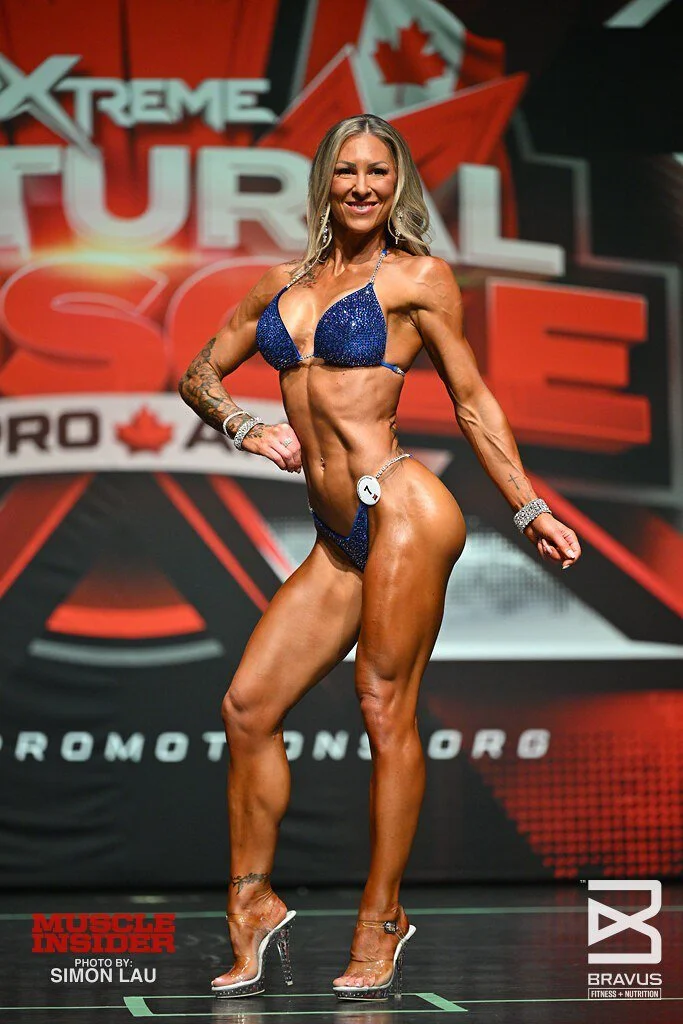
A Real Example: IFBB Bikini Pro Shannyn Creekmore
Shannyn is a natural IFBB Bikini Pro, and yes—she uses the scale.
Not emotionally. Not obsessively. Strategically.
In her case, there is a clear lower threshold:
If her bodyweight drops below a certain level, she loses muscle fullness
Her physique can appear flat on stage, even if conditioning is technically achieved
The scale allows me, as her coach, to know:
When we’re close to peak
When we’re risking going too far
For a natural athlete, this margin matters. Fullness wins shows.
Why the Scale Is Critical During Peak Week
Peak week is not about fat loss—it’s about execution.
During this phase, scale data helps me assess:
Whether carbohydrate loading is translating to muscle fullness
If fluid shifts are occurring as planned
Whether stress or under-recovery is flattening the physique
In many cases, an athlete may weigh more at peak than earlier in prep—and that can be exactly what produces a winning look.
The Scale in the Off-Season: A Recovery & Growth Metric
The scale remains relevant once the show is over.
In the off-season, I use it to evaluate:
Metabolic recovery post-prep
How aggressively food can be increased
Whether weight gain is supporting muscle fullness and training performance
How efficiently calories are being utilized
For competitors, especially natural athletes, this phase determines how well you can prep next season.
Why Experience Determines Whether the Scale Is Helpful or Harmful
The scale is only useful when the coach understands:
When weight loss improves a physique
When it starts costing fullness, performance, and health
How individual thresholds differ between athletes
Without that context, the scale becomes noise.
With experience, it becomes precision.
Final Thoughts for Competitors
The scale is not a goal.
It’s not a measure of worth.
And it’s certainly not a prep strategy on its own.
But when used correctly, it becomes a powerful tool to:
Protect muscle
Optimize peaking
Prevent over-dieting
Extend competitive longevity
In contest prep, looking your best matters more than weighing less.
And sometimes, the scale helps us know exactly when we’ve arrived.